
Overview
- Affiliate marketing tools are the software you use to find offers, research keywords, write content, manage links and email your audience. A beginner can start with a free stack and add paid tools only after earning a first commission.
- Amazon Associates uses a 24-hour cookie and fixed category commissions of roughly 1-10% (UpPromote, 2026), so low rates and a short buying window make traffic quality more important than volume.
- The best affiliate marketing tools for a beginner in this review are a general AI assistant (ChatGPT or Claude), the Semrush free plan, Lasso for links and Kit for email, with Writesonic and Koala AI as paid writing options.
- The FTC Endorsement Guides (16 CFR Part 255) require a clear disclosure of your affiliate relationship, placed close to the links (Track360, 2026).
- My costliest early mistake was buying affiliate marketing tools before I had a niche, a site or any visitors. Spend nothing until your first 10 articles are published.
What Is Affiliate Marketing and What Are Affiliate Marketing Tools?
Affiliate marketing is a performance-based business model. You recommend a product through a tracked link, and the company pays you a commission when a reader buys. Affiliate marketing tools are the software that supports each step, from finding offers and researching keywords to writing, linking, tracking and emailing.
Here is an everyday comparison. Imagine a friend opens a restaurant and hands you a stack of referral cards. Each time someone shows up with your card and eats there, your friend pays you a thank-you. The card is your affiliate link, the restaurant is the merchant (the company that sells the product), and the thank-you is your commission.
Online, the “card” is a link with your unique ID inside it. When a visitor clicks, a cookie (a small text file stored in the visitor’s browser) remembers your ID. If that visitor buys before the cookie expires, the company knows you sent them.
Most beginners think they need ten subscriptions on day one. I thought the same. In practice, you need about six types of software, and almost every type has a free option.
| Tool type | What it does | Example | Free option? |
|---|---|---|---|
| Keyword research | Shows what people search for | Semrush | Yes, limited daily searches |
| AI writing assistant | Builds outlines, drafts and edits | ChatGPT, Claude | Yes |
| Link management | Organizes, displays and updates affiliate links | Lasso | Yes, Lite tier |
| Email marketing | Lets you own your audience | Kit | Yes, with subscriber limits |
| Affiliate network | Hosts offers and tracks sales | CJ Affiliates, ClickBank | Free to join |
| Analytics | Reports traffic and clicks | Google Analytics, Search Console | Yes |
Pricing and free-plan details in the table come from 2026 reviews by lemlist, Layer3 Labs and AffiliateBooster. Plans change often, so check each vendor’s page before you buy.

Who Am I and Why Can You Trust These Affiliate Marketing Tools Reviews?
I have worked as an affiliate marketer for 8 years. I have built niche review sites, run email lists, promoted software and physical products, and paid for far more affiliate marketing tools than I needed. This guide is the one I wish I had in my first month.
My first site covered [YOUR FIRST NICHE]. For [NUMBER] months it earned nothing. I assumed the problem was missing software, so I bought more software. That diagnosis was wrong, and it cost me real money.
The actual problem was simple: I had few articles, no search traffic and no email list. No tool fixes an empty site.
Every tool in the review section went through the same four questions:
- Does it save a beginner real time on a task they already do?
- Is there a free plan or free trial to test it before paying?
- Does the price make sense before the first commission arrives?
- What annoys me about it after a few weeks of use?
How Does Affiliate Marketing Work? A Step-by-Step Breakdown
Affiliate marketing works in six steps: you join a program, receive a tracking link, publish helpful content, a visitor clicks, a cookie records your ID, and you earn a commission if they buy within the cookie window. Everything else is detail around these six steps.
- Join an affiliate program directly with a company or through an affiliate network (a marketplace that hosts many programs and handles tracking and payments).
- Receive a unique tracking link tied to your account.
- Publish content such as a review, a comparison or a tutorial that includes the link.
- A reader clicks your link and lands on the merchant’s site.
- The cookie stores your ID in the reader’s browser for a set number of days.
- If the reader buys inside that window, the merchant credits your commission.
Five terms appear in every program’s rules, so learn them now:
| Term | Plain-English meaning |
|---|---|
| Commission | The share or flat fee you earn per sale |
| Cookie duration | How long after a click you can still earn from a purchase |
| Recurring commission | A payment you earn every month while the customer keeps paying |
| Payout threshold | The minimum balance before the company pays you |
| EPC (earnings per click) | Average money earned per 100 clicks, often shown by networks |
Cookie duration shapes your income more than most beginners expect. Amazon Associates uses a 24-hour cookie, and the window extends up to 90 days only for items a shopper adds to their cart within that first day (Digistore24, 2026). Commissions are fixed by product category and run from about 1% to 10% (UpPromote, 2026).
I learned this the hard way. In my second year I promoted cheap physical products through Amazon. Readers clicked, but most bought days later, after the cookie had expired. When I moved toward software with longer windows and recurring payments, the same traffic earned far more.

How Much Can a Beginner Really Earn from Affiliate Marketing?
Most beginners earn little or nothing for the first several months, because search traffic takes time to build. Income appears after consistent publishing, and it follows a simple formula: traffic, multiplied by the share of readers who click, multiplied by the share who buy, multiplied by your commission.
Here is an illustrative example. These numbers are made up to show the math. They are not a promise.
| Step | Number | Result |
|---|---|---|
| Monthly visitors | 2,000 | |
| Click-through rate (3% click an affiliate link) | 60 clicks | |
| Conversion rate (5% of clickers buy) | 3 sales | |
| Commission per sale | $30 | $90 per month |
That $90 explains why beginners quit. Growth comes from raising each number in the formula: more visitors, better article placement for links, a more relevant product and a higher-paying program.
My own first commission arrived after [NUMBER] months and was [YOUR AMOUNT]. It was small, but it proved the system worked. After that, each new article had a clear job.
Honest expectation: plan for 6 to 12 months of publishing before income feels meaningful. Anyone who promises faster results is selling something.
My 6 Biggest Beginner Mistakes with Affiliate Marketing Tools (and How to Avoid Them)
My six biggest mistakes were buying software too early, choosing a niche only for money, publishing unedited AI drafts, ignoring cookie rules, hiding my disclosure and tracking nothing. Each one cost me time or money, and each is easy to avoid once you know about it.
Mistake 1: Buying Paid Software Before Having Traffic
Paid software is wasted when your site has no visitors to measure. In my second year I paid for an SEO suite, a premium writing tool and a link tracker in the same month. My site had almost no traffic, so the dashboards showed empty graphs.
My rule now: pay for a tool only when its free version blocks something I have already proven I need.
Mistake 2: Choosing a Niche Only Because the Commissions Were High
A high commission does not help if you run out of things to say. I once built a site in a finance software niche I had no interest in. After a handful of articles I had nothing original to add, and the site stalled.
Pick a topic where you can write from real use. Your experience is the part a competitor cannot copy.
Mistake 3: Publishing Raw AI Drafts Without Editing
Unedited AI text can contain wrong prices, outdated features and confident mistakes. I published a batch of lightly edited drafts and later heard from a reader that one price was wrong. That correction damaged trust faster than any ranking drop.
I now use AI for outlines and first drafts, then verify every fact and add my own experience.
Mistake 4: Ignoring Cookie Duration and Commission Structure
Cookie length and commission type decide how much a click is worth. I once promoted a product with a short cookie and a one-time payment, then compared it to a competitor with a 60-day cookie and monthly payments. The second offer paid more on lower traffic.
Read the program terms before you write a single word about the product.
Mistake 5: Putting the Disclosure at the Bottom of the Page
A disclosure buried in the footer does not meet FTC expectations. The agency’s guidance says disclosures should sit close to the promotional content, not tucked into a sidebar or footer (FTC Endorsement Guides FAQ, via Sonix, 2026).
A program manager once asked me to fix my pages, and I moved the disclosure to the top of every post the same day.
Mistake 6: Not Tracking Which Links Earn Money
Using one link everywhere hides what works. For months I placed the same product link across a dozen articles and could not tell which article earned the sale.
Create a separate tracking ID or sub-ID for each article or placement. Within weeks you will see which pages deserve updates.
How to Choose a Niche and Affiliate Programs Before You Buy Any Affiliate Marketing Tools
Choose a niche where you can write from real experience, where readers already search for buying advice, and where programs pay recurring commissions or use cookies of at least 30 days. Pick the niche first, then pick affiliate marketing tools to support it.
Software and AI tools are a good beginner niche for one reason: many software companies pay recurring commissions. You recommend a tool once, and you earn every month the customer stays subscribed.
Here are sample programs from 2026 reviews. Terms change, so confirm them on each program’s page.
| Program | Cookie duration | Commission |
|---|---|---|
| Amazon Associates | 24 hours, extended by cart additions (Digistore24, 2026) | Fixed by category, about 1-10% (UpPromote, 2026) |
| Writesonic | 60 days | 20% recurring for up to 12 months (OutlierKit, 2026) |
| Rytr | 60 days | 30% recurring for 12 months (OutlierKit, 2026) |
| Kit (formerly ConvertKit) | Check program page | 50% recurring for the first 12 months (Inkfluence AI, 2026) |
Use this simple niche test before you commit:
- Can you write 20 article ideas from your own experience?
- Do products in this niche have a clear price and a clear buyer?
- Do at least two programs pay recurring or long-cookie commissions?
If you answer no to any of these, pick a different niche.
What Are the Essential Affiliate Marketing Tools Every Beginner Needs?
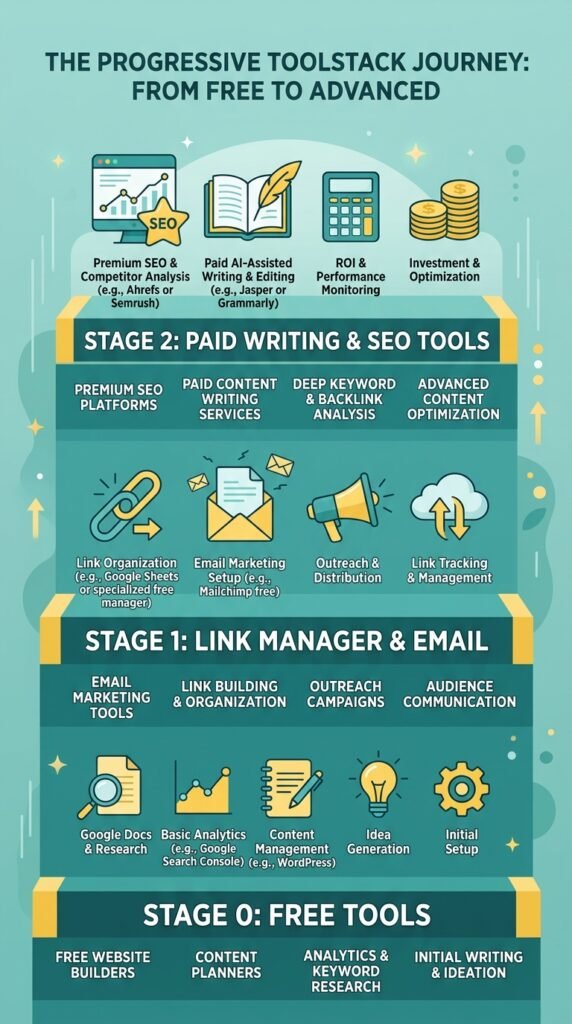
A beginner needs six categories of affiliate marketing tools: a keyword tool, an AI writing assistant, a link manager, an email platform, an affiliate network and free analytics. Add them in stages, because each stage unlocks only after you finish the one before.
| Stage | When | What to use | Monthly cost goal |
|---|---|---|---|
| Stage 0 | Before any articles | Free AI assistant, Semrush free plan, Google Search Console | $0 |
| Stage 1 | After about 10 published articles | Add a link manager and an email tool | Low |
| Stage 2 | After your first commissions | Add a paid writing or SEO tool | Paid out of earnings |
The staging rule protects your budget. Pay for software out of affiliate income, not out of savings, until the site proves itself.
Free analytics tools deserve special attention. Google Search Console (a free Google service that shows which searches bring visitors to your site) tells you which articles to update first.
Honest AI Tools and Software Reviews: Affiliate Marketing Tools I Would Pick Today
These are the eight affiliate marketing tools I would consider today, ranked by value for a complete beginner. Prices below come from 2026 reviews and vary by plan and billing period, so check the live pricing page before paying.
Pricing really does vary between sources. Across four 2026 reviews, Jasper’s starting price appeared as $39, $49, $59 and $69 per month (Digistore24, 2026; eesel, 2026; AffiliateBooster, 2026; AIToolsTeam, 2026). That gap is why I never trust a single price quote.
1. ChatGPT and Claude (General AI Assistants): Best Free Starting Point
Both are general AI assistants you chat with to outline posts, rewrite paragraphs and brainstorm article ideas. Each has a free tier, and the paid plans of each are listed at $20 per month (AffiliateBooster, 2026).
Best for: Complete beginners who want help with outlines and editing.
What I like: One subscription covers many jobs, and you can ask follow-up questions in plain language.
What annoys me: Neither knows your product details unless you paste them in, and both can state wrong facts with confidence.
Skip if: You want one-click, SEO-scored articles with live product data.
2. Writesonic: Best for SEO Articles and AI Search Visibility
Writesonic is an AI writing platform built around SEO articles and visibility in AI search results. Reviews quote starting prices from $16 to the high $70s per month depending on plan (AffiliateBooster, 2026; Layer3 Labs, 2026).
Best for: Affiliates who publish regularly and want SEO guidance inside the writing tool.
What I like: It combines drafting, site audits and AI-search tracking in one place.
What annoys me: The wide pricing range makes budgeting confusing, and a suite this broad can dilute the writing quality (Layer3 Labs, 2026).
Skip if: You have not yet published your first 10 articles.
3. Koala AI: Best for One-Click Affiliate Articles
Koala AI writes SERP-aware articles (articles built from what already ranks on page one of search results) with live product data. Plans start at $9 per month for 15,000 words (AffiliateBooster, 2026).
Best for: Product-review sites, especially Amazon-based ones.
What I like: The entry price is low, and it can pull in product details for review posts (Layer3 Labs, 2026).
What annoys me: One-click output still needs a human edit for voice and accuracy.
Skip if: Your niche depends on first-hand testing and personal stories.
4. Jasper: Best for Brand Voice at Scale
Jasper is a premium AI copywriting platform for blog posts, ads and email. Reviews list its price between $39 and $69 per month depending on plan (Digistore24, 2026; AIToolsTeam, 2026), and one reviewer calls it steep for individual beginners (AffiliateBooster, 2026).
Best for: Affiliates already earning income who publish 10 or more articles per month.
What I like: Drafts come out clean and consistent in tone.
What annoys me: I could not justify the cost until the site earned money.
Skip if: You are in Stage 0 of the stack above.
5. Frase: Best for Content Briefs and Research
Frase builds SEO content briefs by analyzing top-ranking pages, questions people ask and related terms. Reviews place it around $39 to $45 per month (Layer3 Labs, 2026; AIToolsTeam, 2026).
Best for: Affiliates who write their own drafts and want a research layer.
What I like: Briefs save the first hour of every article.
What annoys me: Its built-in AI writer is weaker than dedicated writing tools (Layer3 Labs, 2026).
Skip if: The Semrush free plan and a general AI assistant already cover your research.
6. Semrush: Best for Keyword Research (Free Plan First)
Semrush is an SEO suite for finding keywords and checking competitors. The free plan allows 10 keyword searches per day, and paid plans start at $139.95 per month (lemlist, 2026).
Best for: Finding article topics with real search demand.
What I like: The free plan is enough to plan your first batch of articles.
What annoys me: The paid price is high for a solo beginner (Layer3 Labs, 2026).
Skip if: You have not used up the free daily searches yet.
7. Lasso: Best for Managing Affiliate Links
Lasso is a WordPress plugin built for affiliate sites. It creates product display boxes and comparison tables, and it manages disclosures. It has a free Lite tier, with paid plans around $19 per month on annual billing (Layer3 Labs, 2026).
Best for: WordPress sites with many affiliate links to keep current.
What I like: Updating one link updates every page that uses it.
What annoys me: The best features sit on paid tiers, and it works only with WordPress (Layer3 Labs, 2026).
Skip if: Your site is not on WordPress.
8. Kit (Formerly ConvertKit): Best for Email and Owning Your Audience
Kit is an email platform for creators. It is free up to 10,000 subscribers, and Creator plans start at $39 per month (lemlist, 2026).
Best for: Turning one-time visitors into subscribers you can reach again.
What I like: Search traffic can drop overnight, but an email list stays yours.
What annoys me: Free-plan limits push you toward paid tiers once your list grows.
Skip if: You have no lead magnet (a free download or guide that earns the subscription) to offer yet.
Affiliate Marketing Tools Comparison Table: Price, Best Use and When to Buy
The table below compares all eight tools on entry price, best use and the stage at which a beginner should buy. Prices come from the 2026 reviews cited above and can change, so use them for planning only.
| Tool | Category | Entry price (2026 reviews) | Best use | Buy at stage |
|---|---|---|---|---|
| ChatGPT / Claude | AI assistant | Free tier, $20 paid | Outlines, editing | Stage 0 |
| Writesonic | AI writing and SEO | $16 to high $70s | SEO articles | Stage 2 |
| Koala AI | AI writing | From $9 | Product reviews | Stage 1 or 2 |
| Jasper | AI copywriting | $39 to $69 | Brand voice at scale | Stage 2 |
| Frase | SEO briefs | About $39 to $45 | Research | Stage 2 |
| Semrush | Keyword research | Free plan, $139.95 paid | Topic discovery | Stage 0 (free) |
| Lasso | Link management | Free Lite, about $19 paid | Link updates | Stage 1 |
| Kit | Email marketing | Free to 10,000 subscribers | Audience ownership | Stage 1 |
My beginner stack for the first three months is the free tier of an AI assistant, the Semrush free plan, Google Search Console, the Lasso Lite tier and the Kit free plan. Total cost: $0 in tools beyond hosting.
How to Use AI Writing Software Without Hurting Your Credibility
Use AI to speed up outlines, first drafts and edits, then add your own experience and check every fact before you publish. AI affiliate marketing tools save time on structure but cannot replace first-hand testing, accurate pricing or your honest opinion.
The Jasper pricing gap above is a real example. A tool-generated draft could pick any one of those four prices and present it as fact. A human check catches it.
This is the workflow I follow for every review:
- Write a short brief: the reader, the product and the one question the article must answer.
- Ask an AI assistant for an outline, then rearrange it to match what I actually know.
- Generate a rough draft section by section.
- Verify every price, feature and statistic against the vendor page and a named source.
- Add first-hand details such as screenshots, test results and mistakes I made.
- Rewrite the draft in my own voice and read it aloud once.
Step 5 matters most. Readers and search engines both reward details that only a real user would know.
How to Start Affiliate Marketing with Free Affiliate Marketing Tools in 7 Days
You can launch a first affiliate site in 7 days using free affiliate marketing tools. The week gets you to published, not to paid. Treat it as setup and expect income to come later.
Day 1: Pick a Niche and Write 20 Article Ideas
Use the niche test from earlier. Write down 20 questions a buyer in that niche would type into Google, using your own experience as the source.
Day 2: Join Two or Three Affiliate Programs
Apply to programs that fit your niche. Compare cookie duration, commission type and payout threshold before you apply.
Day 3: Set Up Your Website
Set up a simple WordPress site with a clean theme and four pages: Home, About, Contact and an affiliate disclosure page. Add Google Search Console after launch.
Day 4: Run Free Keyword Research
Use the Semrush free plan, Google autocomplete and the People Also Ask boxes in search results. Choose five low-competition questions for your first articles.
Day 5: Draft Your First Review with an AI Assistant
Follow the six-step workflow above. Your first review should answer one buyer question and include at least one detail from real use.
Day 6: Add Links and Your Disclosure
Insert your tracking links with a unique ID for this article. Place the disclosure above the first affiliate link.
Day 7: Publish and Set Up Email Capture
Publish the article, submit it in Search Console and add a Kit signup form. Then repeat the process for article two.
| Problem | Likely cause | Solution |
|---|---|---|
| Program application rejected | Site too new or thin | Publish 5 to 10 articles first, then reapply |
| No clicks on links | Links buried or product mismatch | Move the link higher and match the reader’s question |
| Clicks but no sales | Weak offer or short cookie | Compare programs and review the landing page |
How Do You Disclose Affiliate Links Under FTC Rules?
Place a clear, plain-language disclosure close to your affiliate links that says you earn a commission if readers buy. In the United States, the FTC Endorsement Guides (16 CFR Part 255) require disclosure of any material connection, and a 2023 update tightened what counts as clear and conspicuous (Track360, 2026).
Here is sample wording in my own style: “I earn a commission if you buy through links in this post, at no extra cost to you.”
Follow these placement rules:
- Put the disclosure at the top of the post or directly beside the first affiliate link.
- Repeat it on pages where affiliate links are far from the original disclosure.
- Avoid a lone “affiliate link” label as your only disclosure, since the FTC guidance questions whether that wording is adequate (FTC Endorsement Guides FAQ, via Sonix, 2026).
- Disclose in the same video, story or post where the endorsement appears when you promote on social platforms (Track360, 2026).
This is general information, not legal advice. Rules differ by country, so check your own market’s advertising regulator.
How Can You Spot Biased Software Reviews Before You Buy?
Biased reviews hide weaknesses, repeat the vendor’s pricing without checking it and place the author’s own product at the top of the list. While researching this article, several “best tools” roundups I read were published by companies that included their own product in the ranking.
Run every review through this checklist:
- Does the author name at least one real drawback for each tool?
- Does the review show first-hand evidence such as screenshots, test results or dated updates?
- Do the prices match the vendor’s live pricing page?
- Does the author disclose affiliate relationships?
- Does the list include alternatives that the author does not earn money from?
If a review fails two or more of these checks, treat it as marketing. Use it only as a starting point for your own research.
My own reviews follow the same standard. Every tool above has a stated drawback, and the pricing note tells you where each number came from.
Frequently Asked Questions About Affiliate Marketing Tools
What are affiliate marketing tools?
Affiliate marketing tools are software products that help you find offers, research keywords, write content, manage links, track clicks and email subscribers. Common types include keyword tools, AI writing assistants, link managers, email platforms and affiliate networks.
What are the best affiliate marketing tools for beginners?
The best affiliate marketing tools for beginners are free ones: a general AI assistant, the Semrush free plan, Google Search Console, the Lasso Lite tier and the Kit free plan. Add paid writing or SEO tools only after you earn your first commissions.
Are AI affiliate marketing tools worth paying for?
AI affiliate marketing tools are worth paying for once your site publishes consistently and earns money. Before that point, free tiers of general AI assistants cover most beginner needs, and the paid savings in time rarely beat the cost.
Do I need a website to start affiliate marketing?
You do not strictly need a website, because you can promote through YouTube, social media or email. A website still gives you control over your content and lets you collect search traffic, which is why most affiliate marketing tools in this guide target site owners.
How much money do I need to start affiliate marketing?
You can start with $0 in software, since the free stack above covers research, writing, links and email. Your main costs are a domain name and hosting for a website, and those prices vary by provider.
How long does it take to earn the first affiliate commission?
The timeline varies by niche and publishing speed. In my experience, plan for several months of steady publishing before the first commission arrives, and 6 to 12 months before income feels meaningful.
What is the difference between an affiliate network and an affiliate program?
An affiliate program is one company’s offer to pay you for referrals. An affiliate network is a marketplace that hosts many programs and handles tracking and payment. CJ Affiliates and ClickBank are network examples (lemlist, 2026).
Do I have to disclose affiliate links?
Yes, in the United States and many other countries you must disclose affiliate relationships clearly. The FTC Endorsement Guides apply to affiliate links, and the disclosure should sit close to the promotion (Track360, 2026).
Can AI write my affiliate reviews?
AI can draft reviews, but you should verify every fact and add first-hand experience before publishing. Unedited AI drafts can contain wrong prices and outdated features, which damages reader trust.
Takeaways: What to Do This Week
- Start with free affiliate marketing tools and pay for software only out of affiliate income.
- Choose a niche where you can write from real experience and where programs pay recurring or long-cookie commissions.
- Read cookie duration and commission terms before promoting any product.
- Use AI to outline and draft, then verify every price and add your own testing.
- Place a clear disclosure near your affiliate links on every page.
- Track each link with its own ID so you know which article earns the sale.
- Plan for 6 to 12 months of consistent publishing before expecting steady income.