Affiliate marketing is a performance-based arrangement where a business pays you a commission for sending customers its way. You share a special tracking link. When someone clicks it and completes a purchase or other action, you get paid. If nobody buys, you earn nothing and the business pays nothing.
Think of it as a finder’s fee. A real estate agent who introduces a buyer to a seller gets a cut when the deal closes. Affiliate marketing works the same way, except the introduction happens online through a blog post, video, email, or social media post.
The business is called the merchant (also called the advertiser or brand). The person promoting is the affiliate (also called the publisher or partner). Both terms are used throughout this guide, but “merchant” and “affiliate” are the standard ones.
Affiliate marketing works through a tracking link that records which affiliate sent each customer. The merchant pays the affiliate only when that customer completes a defined action. The whole process takes five steps, and most of it runs automatically once the link is placed.
The customer pays the same price whether or not they use an affiliate link. The commission comes out of the merchant’s marketing budget.
An affiliate marketing relationship has four parties: the merchant, the affiliate, the network, and the customer. The network is optional, since some merchants run their own programs. Each party has a clear job, and the table below shows who does what and who gets paid.
| Party | Role | How They Benefit |
|---|---|---|
| Merchant | Creates and sells the product | Gains sales without paying for ads that don’t convert |
| Affiliate | Promotes the product to an audience | Earns a commission on each qualifying action |
| Affiliate network | Provides tracking, reporting, and payments | Takes a fee or share from the merchant |
| Customer | Buys the product | Gets a recommendation from a source they trust |
Networks matter because they handle the technical and legal work. Without one, a small affiliate has to trust each merchant to track sales honestly and pay on time.
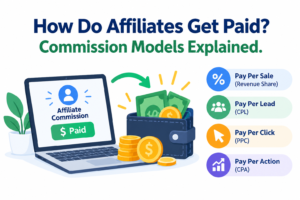
Affiliates are paid through one of three main commission models: pay per sale, pay per lead, or pay per click. Pay per sale is the most common. The right model depends on what the merchant wants and how easy the action is for a customer to complete.
| Model | Also Called | What Triggers Payment | Typical Use |
|---|---|---|---|
| Pay per sale | Cost per sale (CPS) | A customer completes a purchase | Physical products, software subscriptions |
| Pay per lead | Cost per action (CPA) | A visitor fills out a form or starts a free trial | Insurance quotes, financial services |
| Pay per click | Cost per click (CPC) | A visitor clicks the link, whether or not they buy | Traffic-focused campaigns |
Commissions are usually set as a percentage or a flat fee. Amazon Associates, for example, pays a percentage that varies by category, up to 10% for most product types (Amazon Associates Program, 2025). Software companies often pay recurring commissions, meaning the affiliate earns each month the customer stays subscribed.
Affiliates promote products wherever they have an audience that trusts them. Blogs and YouTube channels are the most common starting points, because a detailed review or tutorial answers a buying question at the exact moment someone is ready to act.
Common channels include:
Search engine optimization (SEO) is the main traffic source for many blog-based affiliates. A page that ranks for “best budget laptops” can send buyers to affiliate links for months without new ad spend.
A typical example is a blogger who reviews standing desks and links to one on Amazon. A reader clicks, buys within 24 hours, and the blogger earns a commission on that sale. Amazon’s standard tracking window is 24 hours, though items added to a cart can be credited for longer (Amazon Associates Program, 2025).
Here is an illustrative calculation with made-up numbers to show how the math works:
Real results vary widely. Traffic, audience trust, product price, and commission rate all change the outcome.
Earnings range from nothing to full-time incomes, and no reliable average exists for beginners. Income depends on traffic volume, audience fit, commission rate, and conversion rate (the share of visitors who buy). Most new affiliates earn little for the first several months while they build content and an audience.
Three factors move earnings the most:
Treat any claim of fast, guaranteed income with suspicion. Affiliate marketing rewards steady publishing, not shortcuts.
You start affiliate marketing by choosing a niche, building an audience channel, joining programs, and publishing helpful content that includes your links. You need no inventory, no shipping setup, and no product of your own. The steps below follow the order most beginners use.
The FTC requires US affiliates to clearly disclose any financial relationship with a merchant. The rules come from the FTC’s Endorsement Guides (16 CFR Part 255), last updated in 2023. A disclosure must be easy to notice and placed near the link, not hidden in a footer.
A simple line works: “I earn a commission if you buy through links on this page.” Other countries have their own rules, such as the UK’s Advertising Standards Authority guidelines. Check the requirements for every region your audience lives in.
The most common mistake is promoting products only for the commission without testing or understanding them. Readers notice, trust drops, and sales follow. Avoiding the mistakes below saves months of slow progress.
Affiliate marketing differs from both because the affiliate never handles products, customer service, or fixed-fee sponsorships. The table below compares the three models on the points that matter most to beginners.
| Factor | Affiliate Marketing | Dropshipping | Influencer Marketing |
|---|---|---|---|
| Who sells the product | The merchant | You, through your own store | The brand, via the influencer’s post |
| Handles customer service | Merchant | You | Brand |
| Upfront cost | Very low | Moderate (store, ads) | None for the influencer |
| Payment type | Commission | Profit margin | Flat fee, commission, or both |
| Main risk | Low traffic means low income | Supplier and refund problems | Audience size limits deals |
The models overlap. Many influencers use affiliate links as part of their sponsorship deals.
Affiliate marketing is earning a commission by recommending a company’s product through a unique link. When someone buys through your link, the company pays you a share of the sale. You never own, store, or ship the product.
You join an affiliate program and receive a tracking link. A cookie records visitors who click it. If they complete a purchase or other qualifying action, the merchant credits you and pays the commission after verification.
Most affiliate programs are free to join. Some networks and merchants review applications and reject sites with no content or traffic. Your main costs are usually a domain, hosting, or the time spent creating content.
Yes, affiliate marketing is legal. In the US you must disclose your commission relationship clearly under FTC rules (FTC Endorsement Guides, 2023). Other countries require similar disclosures.
Beginners can earn money, but results usually take months. Income depends on traffic, audience trust, and the products you promote. Most new affiliates should expect a slow start while they build content.
An affiliate is the person or site promoting products. An affiliate network is a platform that connects affiliates with many merchants and handles tracking, reporting, and payments. Examples include Awin, Impact, and CJ Affiliate.
No, but a website helps. You can also promote through YouTube, email newsletters, or social media. Some programs, including Amazon Associates, require you to submit at least one platform when you apply.