
TL;DR
- To start affiliate marketing, pick a narrow niche, choose one content channel, join affiliate programs, publish honest buyer-focused content with a clear disclosure, and then drive traffic and build an email list.
- You can begin with $0 and 5 to 8 hours a week, but most beginners earn between $0 and $1,000 a month in the first year (QualityUnit, 2025).
- Experience pays: affiliates with 3+ years of experience earn 9.45 times more than beginners (Authority Hacker, 2025), so the first 90 days should aim at a first commission, not a monthly income target.
- Judge every program with a 5-point scorecard (commission, cookie length, payout threshold, payment method, approval rules) before you write a word.
- Disclose every affiliate link near the link itself. Both US and UK regulators expect it (Manatt, 2023; ASA and CMA, 2023).

What Is Affiliate Marketing and How Does It Work?
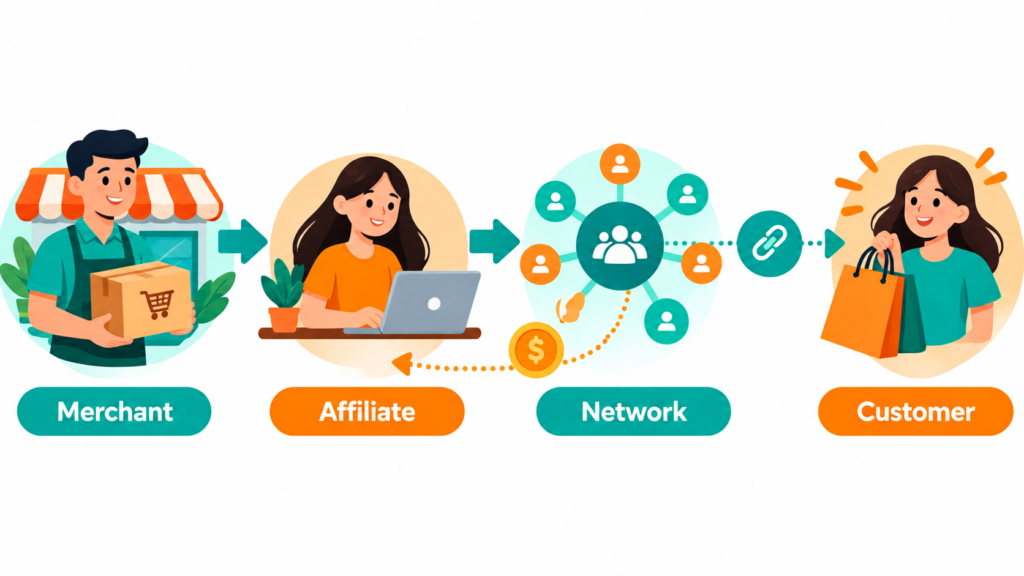
Affiliate marketing is a performance-based model where you earn a commission by promoting another company’s products or services through a unique tracking link. The company pays you only when a reader buys, or completes a set action such as a free trial signup. You never handle stock, shipping, or customer support.
Four parties are involved in every sale. The table below shows who does what.
| Player | Role | Example |
|---|---|---|
| Merchant (also called advertiser) | Owns the product and pays the commission | A coffee machine brand |
| Affiliate (also called publisher) | Recommends the product and earns the commission | You |
| Network | Hosts the programs, tracks sales, and handles payments | Awin, ClickBank, PartnerStack |
| Customer | Clicks your link and buys | A reader of your review |
How a Tracking Link and Cookie Work
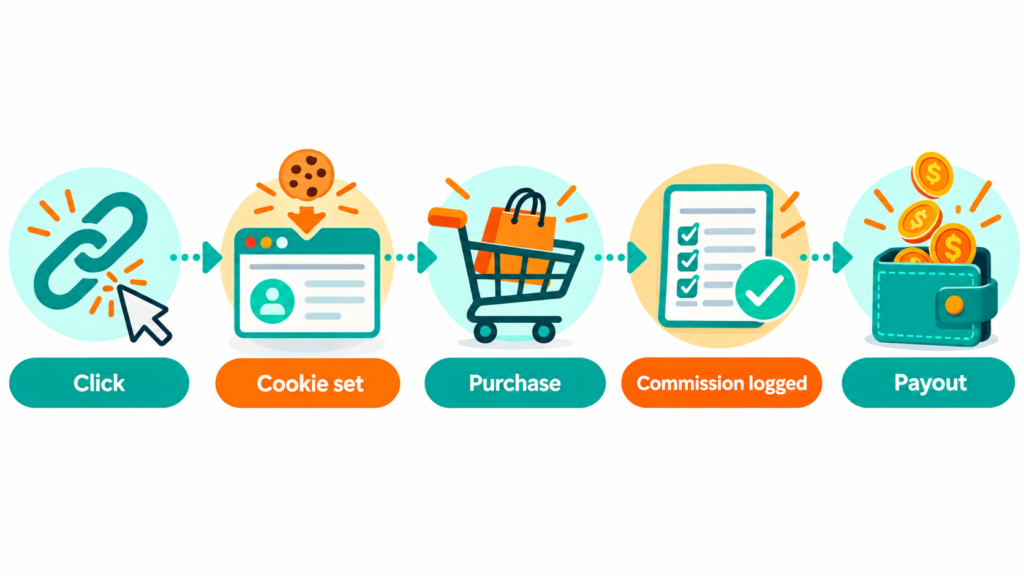
web address with your ID built in. When someone clicks it, the merchant’s system saves a small file in their browser called a cookie. If that person buys before the cookie expires, the sale is credited to you.
Cookie length matters because it decides how long you get credit after the click. Amazon Associates uses a 24-hour window for most clicks, while many other programs run 30 to 90 days or longer (Simply Business, 2025).
Think of it as a referral bonus at a shop. You send a friend in, and the shop pays you only if your friend actually buys something.
What Are the Three Types of Affiliate Commission?
Affiliate programs pay in three ways, and each one suits a different kind of content:
- One-time commission: You earn a percentage or fixed amount once per sale, which is the usual model for physical products.
- Recurring commission: You earn a percentage every month for as long as the customer stays subscribed, which is common in software.
- Per-lead payment (CPA, or cost per action): You earn a fixed fee when someone completes an action such as a signup, even without a purchase.
Worked Example: Why Recurring Pay Matters
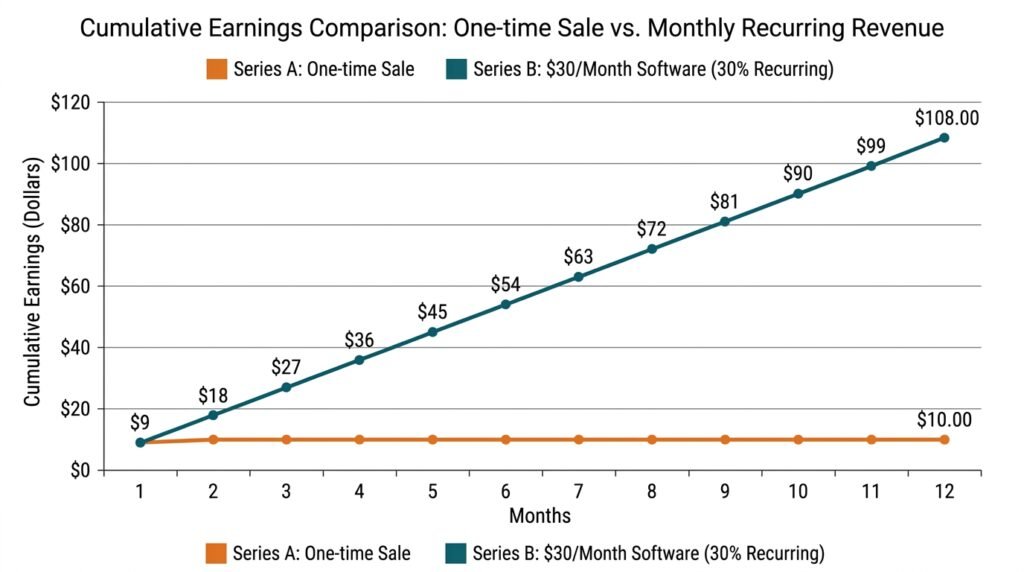
Take a $50 product at a 20% commission. You earn $10 once.
Now take software that costs $30 a month and pays 30% recurring. You earn $9 in month one and $9 again in every month the customer stays. After 12 months, that one customer has paid you $108.
For a beginner with little traffic, a single customer who keeps paying is worth more than several one-time sales. That is why recurring programs deserve a place on your shortlist.
How Much Money and Time Do You Need to Start?
You can start with $0 and 5 to 8 hours a week. A low-cost path of roughly $50 to $150 in the first year adds your own domain name and basic hosting. Paid tools, courses, and ads can wait until you earn your first commission.
The costs below are editorial estimates based on typical domain and shared hosting prices.
| Item | Free path | Low-cost path | What you get |
|---|---|---|---|
| Home base | Free blog platform, YouTube channel, or newsletter tool | Own domain plus shared hosting (about $50-150 in year one) | Control over your content and brand |
| Email list | Free plan of an email tool | Same free plan | A direct line to readers |
| Research | Google search, free keyword tools | One paid SEO tool, only after first sales | Faster keyword research |
| Content | Your own writing, screenshots, and recordings | Same | Proof that you used the product |
| Time | 5-8 hours a week | 5-8 hours a week | Steady output for 90 days |
How Long Until Your First Click, Sale, and Payout?
Most beginners who publish steadily see first clicks within 4 to 12 weeks, a first sale somewhere between month 2 and month 6, and a first payout a few weeks after that. These ranges are editorial estimates, because no survey tracks time to first sale reliably.
The honest picture comes from earnings data: income grows slowly in year one and accelerates later, as the next section shows.
What Hidden Costs Do Most Guides Skip?
Three costs rarely get mentioned, and each can slow a beginner down:
- Payout thresholds: Awin pays out once you reach 20 USD, EUR, or GBP (Awin, 2025), while ClickBank lets you set your own threshold and many accounts sit near $100 (UpPromote, 2026). Earnings below the threshold stay unpaid.
- Approval deadlines: Amazon Associates closes your account if you do not make 3 qualifying sales within 180 days (Simply Business, 2025).
- Course upsells: Paid courses are optional. Free documentation from each network covers the basics.
How Much Can Beginners Realistically Earn?
Most beginners earn between $0 and $1,000 a month during year one, and many earn nothing in the first three months (QualityUnit, 2025). Income rises with experience, content quality, and traffic. Treat the first 90 days as a test of your process, not a paycheck.
What the Data Says
Three data points set realistic expectations:
- Authority Hacker surveyed 2,270 affiliate marketers and found an average income of $8,038 a month, but that average is pulled up by experienced earners (Authority Hacker, 2025).
- The same survey found that affiliates with 3+ years of experience earn 9.45 times more than beginners, and it describes a two-year “beginner’s hump” that newcomers must get through (Authority Hacker, 2025).
- A 2025 roundup by Tolt reports that 41% of affiliate marketers earn less than $1,000 a month and 23% earn $0 (Tolt, 2025).
The takeaway is simple. The big numbers you see online come from people with years of compounding content. Your goal in year one is to build the asset that produces those numbers later.
The Income Formula
Affiliate income comes from four numbers multiplied together:
Monthly earnings = visitors x click rate x purchase rate x average commission
Improving any one of them raises income. Beginners usually gain fastest by raising the average commission, because it needs no extra traffic.
Reverse Income Math: How Many Visitors Do You Need for $100?
Start from your target and work backward. The table uses illustrative assumptions (5% of visitors click an affiliate link) so you can see how commission size changes the traffic you need.
| Scenario | Average commission | Sales needed for $100 | Purchase rate | Clicks needed | Visitors needed |
|---|---|---|---|---|---|
| Low-commission physical product | $4 | 25 | 3% | about 833 | about 16,700 |
| Mid-range product or software | $15 | 7 | 3% | about 233 | about 4,700 |
| High-payout offer | $150 | 1 | 2% | 50 | 1,000 |
A high-payout offer needs a small fraction of the traffic. For example, Shopify’s affiliate program pays up to $150 for each full-priced plan referral (Shopify, 2026). That is why a beginner with a small audience often does better promoting fewer, higher-paying offers.
Step 1: How to Choose an Affiliate Niche
Pick a specific, focused topic instead of a broad category, so you can build real authority. Budget travel gear, home espresso makers, and productivity software are examples. A narrow niche has fewer competitors, a clearer reader, and more obvious products to recommend.
The reason narrow works is simple. A site that covers one topic deeply gives readers and search engines a clear signal about what it knows. A site that covers everything gives them no reason to pick it over bigger names.
The 4-Factor Niche Score
Score each niche from 1 to 5 on four factors, then add them up. A total of 14 or more out of 20 is a go.
| Factor | What it asks | How to test it in 15 minutes |
|---|---|---|
| Interest | Can you write about this for 90 days without getting bored? | List 10 topics you could cover today |
| Buyer intent | Do people search for products to buy? | Look for searches with “best”, “review”, “vs”, or “alternatives” |
| Commission potential | Do programs pay well, or pay on repeat? | Check 3 programs for rate and commission type |
| Competition | Can a new site realistically compete? | Search your main keyword and check whether small sites rank on page one |
Here is how three sample niches score. These are editorial examples, not market data.
| Niche | Interest | Buyer intent | Commission | Competition | Total | Decision |
|---|---|---|---|---|---|---|
| Home espresso makers | 4 | 5 | 3 | 3 | 15 | Go |
| General fitness | 4 | 4 | 2 | 1 | 11 | Narrow it down |
| Email tools for newsletter writers | 3 | 4 | 5 | 2 | 14 | Go |
The Narrowing Ladder
If your niche scores below 14, narrow it in three steps: broad topic, narrower topic, specific person. For example: fitness, then home workouts, then home workouts for people with back pain. Each step cuts competition and sharpens the reader you write for.
The 20 Buyer Keywords Test
Before you commit, write down 20 searches that signal intent to buy, such as “best espresso machine under $300” or “Breville vs De’Longhi”. If you cannot reach 20, the niche will not support a content site. Also confirm that at least 3 affiliate programs exist for it.
What Are the Most Profitable Affiliate Niches for Beginners?
Software, web services, and finance tools often pay the most per sale, and software often pays recurring commissions. They also draw the most competition. Physical-product niches pay less per sale but are easier to enter. The table below is an editorial assessment.
| Niche | Typical commission type | Competition |
|---|---|---|
| Software and online tools | Recurring or fixed bounty | High |
| Web hosting and website builders | Fixed bounty per signup | High |
| Personal finance products | Per lead or per signup | High |
| Home and kitchen gear | Percentage of sale | Medium |
| Pet products | Percentage of sale | Medium |
| Hobby and skill-specific gear | Percentage of sale | Low to medium |
Interest matters as much as payout. Authority Hacker’s survey found that 11 of 19 niches averaged over $4,000 a month, so many niches can pay well when you stay with them (Authority Hacker, 2025).
Step 2: Which Content Channel Should a Beginner Pick?
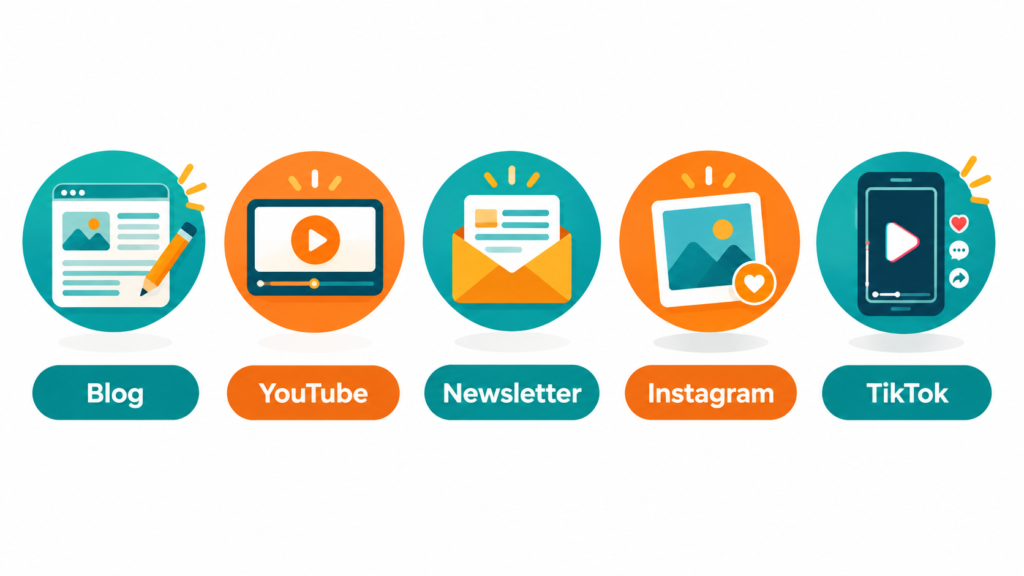
Choose one primary platform to build an audience: a blog or website, a YouTube channel, a newsletter, or social media pages such as Instagram and TikTok. Pick the one that fits your time, skills, and comfort on camera, then stay with it for 90 days.
| Channel | Time to first traffic | Cost | Skills needed | You own the audience? | Best for |
|---|---|---|---|---|---|
| Blog or website | 3-6 months | Low | Writing, basic SEO | Yes | Long-term search traffic |
| YouTube | 2-4 months | Free to low | Video, voice, editing | No | Products that need a demo |
| Newsletter | Depends on promotion | Free to low | Writing, consistency | Yes | Building trust with a small audience |
| 1-3 months | Free | Photos, short video | No | Visual products and lifestyle niches | |
| TikTok | Weeks | Free | Short video, trend sense | No | Fast reach and product demos |
Time-to-traffic figures are editorial estimates. They vary widely by niche and effort.
Personal Brand vs Faceless Brand
A personal brand generally builds trust and raises conversions because readers see a real person using the product. A faceless brand protects your privacy and scales without you on camera, but it needs stronger proof such as screenshots, test data, and original photos.
| Personal brand | Faceless brand | |
|---|---|---|
| Trust | Higher, since readers know who you are | Built through proof and consistency |
| Privacy | Lower | Higher |
| Scaling | Tied to you | Easier to hand off |
| Best for | People comfortable on camera | People who prefer to stay private |
Pick by Constraint
Let your biggest limit decide:
- No face on camera: Choose a blog, or faceless video with screen recordings and voiceover.
- Under 5 hours a week: Choose a newsletter or one blog post a week.
- Need results within 30 days: Choose short video, and keep in mind that platforms can change their rules and reach without notice.
Why One Channel Beats Five
Spreading yourself across five channels means five half-finished efforts and no momentum. Pick one for 90 days. Add a second channel only after the first brings steady clicks.
Platform dependence is real. YouTube, Instagram, and TikTok can change their algorithms or rules at any time, so build an email list next to any social channel (see Step 5).
Step 3: How to Join Affiliate Programs and Networks
Sign up for established merchant programs or affiliate networks that match your niche. After approval, copy your unique tracking links from your dashboard. Apply to 3 to 5 programs, not 30, and choose each one with the scorecard below.
A network works like a marketplace: one account gives you access to many brands. A direct program is like walking into one shop: you apply to that brand alone, often with better terms.
The 5-Point Program Scorecard
Check these five items before you apply:
- Commission: What percentage or fixed amount do you earn, and is it one-time or recurring?
- Cookie length: How many hours or days do you get credit after a click?
- Payout threshold: How much must you earn before the program pays you?
- Payment method: Can you receive the payout in your country (bank transfer, PayPal, Payoneer, or another method)?
- Approval rules: Does the program accept new sites, your country, and your traffic type?
Popular Programs and Networks Compared
The table lists the programs named in Google’s overview plus two common additions. Terms change often, so confirm each one on the program’s own page before you apply. Details below were checked in October 2026.
| Program | Type | Commission | Cookie / tracking | Payout notes | Best for |
|---|---|---|---|---|---|
| Amazon Associates | Direct | Varies by category | 24 hours; cart items can count for up to 90 days (Simply Business, 2025) | Need 3 qualifying sales in 180 days | Physical products with wide appeal |
| Awin | Network | Varies by advertiser | Varies by advertiser | Minimum 20 USD/EUR/GBP (Awin, 2025); small refundable signup fee (Awin, 2026) | Retail, travel, and UK or EU audiences |
| ClickBank | Network and marketplace | Often 50-75% on digital products (UpPromote, 2026) | Varies by offer | You set the threshold; many accounts sit near $100 (UpPromote, 2026) | Digital products, with caution on refunds |
| Shopify | Direct | Up to $150 per full-priced plan referral (Shopify, 2026) | Per program terms | Per program terms | Ecommerce and store-building content |
| PartnerStack | Network | Commonly 15-40% recurring on software (UpPromote, 2026) | Often 30 to 180 days (UpPromote, 2026) | Per program | B2B and SaaS tools |
| Rakuten, Impact, CJ | Networks | Varies by advertiser | Varies by advertiser | Varies by network | Established brands, once you have traffic |
One update many guides still miss: ShareASale shut down on October 6, 2025, and its programs moved to Awin (Awin, 2025). Do not apply to ShareASale. Sign up with Awin instead.
ClickBank deserves an extra caution. Some affiliates report high refund rates on certain products (Tekpon, 2026), and refunds can reverse your commission. Check refund terms before you promote any offer.
How to Get Your Tracking Link After Approval
- Log in to your affiliate dashboard and open the approved program.
- Find the link tool, often called “Links”, “Creatives”, or “Get link”.
- Pick the exact product page you want to send readers to.
- Copy the link with your ID and paste it into your content.
- Click it yourself in a private browser window to confirm it lands on the right page.
Why Do Affiliate Applications Get Rejected?
The most common reasons are an empty site, content unrelated to the brand, traffic from a region the program does not serve, and a missing disclosure. Fix these before you apply.
The “proof of work first” approach helps: publish 3 to 5 quality pieces, then apply with your live URL. Reviewers approve people who clearly have an audience in mind.
Which Affiliate Program Is Best for Beginners?
For physical products, Amazon Associates is the easiest to join, but its 24-hour cookie and low rates mean you need volume. For software, programs on PartnerStack or direct SaaS programs often pay recurring commissions and suit small audiences better. Awin works well for retail and UK or EU readers.
Do You Need a Website to Join Affiliate Programs?
No, but most programs want some public place to see your content. Many networks accept a YouTube channel, a newsletter, or a social media profile, though rules differ by program. Read each program’s terms to see which promotion types it accepts. A simple site gives you the widest range of approvals.
Check Country and Payout Before You Invest Time
Confirm that the program accepts your country and pays in a method you can receive. Some programs pay only through PayPal, bank transfer, or Payoneer. Awin, for example, pays through Payoneer (Awin, 2025). Spending a week on content for a program that cannot pay you is a common and avoidable loss.
Step 4: How to Create Valuable Content With Affiliate Links
Publish helpful, honest reviews, tutorials, comparison guides, or video demonstrations that naturally include your affiliate links. Solve a specific problem for your audience instead of hard-selling. Readers trust a page that helps them decide, and trust is what turns clicks into sales.
What to Publish First: The 10-Piece Starter Plan
Start with content aimed at people close to buying. Someone searching “Product A vs Product B” is further along than someone searching “what is a coffee machine”.
| Content type | Formula | Sample title |
|---|---|---|
| Review | [Product] review | Breville Bambino Review: 3 Months of Daily Use |
| Comparison | [A] vs [B] | Breville Bambino vs Gaggia Classic: Which Is Better for Beginners? |
| Best-for page | Best [product] for [specific person] | Best Espresso Machine for Small Apartments |
| Alternatives | [Product] alternatives | 5 Breville Bambino Alternatives Under $400 |
| Problem guide | How to [solve problem] with [product] | How to Fix Sour Espresso With Your Home Machine |
A good starter mix is 3 reviews, 3 comparisons, 2 best-for pages, and 2 problem-solving guides. Add tutorials and video demonstrations when the product is easier to show than to describe.
How to Solve a Problem Instead of Hard-Selling
Lead with the reader’s problem, show how you tested the answer, and place the link where the reader is ready to act. Here is a before and after:
- Before: “This amazing blender is the best on the market, so buy it now through my link!”
- After: “I blended frozen fruit, ice, and nuts in this model for 30 days. It handled the fruit well but struggled with whole almonds. If you mostly make smoothies, it is a good fit. [Link]”
The second version gives evidence, names a flaw, and tells the reader who the product suits.
Use this proof checklist on every post:
- Include your own photo or screenshot of the product in use.
- Name at least one honest negative.
- Say who should skip the product.
- Explain how you tested it.

Place your first link where the reader first needs it, usually after the recommendation, not in the first line. Too many links make a page look like an ad and lower trust.
How to Disclose Affiliate Links (FTC and Platform Rules)
Tell readers clearly, near the link and before they click, that you earn a commission. The US Federal Trade Commission (FTC) requires a disclosure that is “clear and conspicuous”, meaning difficult to miss and easy for ordinary consumers to understand (Manatt, 2023).
What that means in practice:
- A hashtag such as #endorsement is not clear enough, and a disclosure buried in the comments of a Facebook post does not count (Manatt, 2023).
- For video, the FTC recommends disclosing in the video and in the description near the links (Manatt, 2023).
- On a blog, a disclosure at the bottom of the page is not enough. The disclosure and the endorsement should be visible at the same time (Gordon Law, 2023).
- Civil penalties for violations can reach $53,088 per violation (ReferralCandy, 2025).
UK rules are similar. The Advertising Standards Authority (ASA) and the Competition and Markets Authority (CMA) expect a clear and prominent “Ad” label upfront on content with affiliate links (ASA and CMA, 2023). The ASA’s advice also says not to use “Aff” alone, because consumers are unlikely to understand it as an ad label (ASA, 2026).
Programs add their own rules. Amazon requires its own wording: “As an Amazon Associate I earn from qualifying purchases” (Darkroom Agency, 2026).
Copy these lines and adapt them:
| Where | Disclosure line |
|---|---|
| Blog post (above the first link) | “This post contains affiliate links. If you buy through them, I may earn a commission at no extra cost to you.” |
| YouTube | Say it aloud near the start, and add in the first lines of the description: “Some links below are affiliate links, so I earn a commission if you buy.” |
| Social caption | “Ad: I earn a commission from the links in this post.” |
| Amazon links | “As an Amazon Associate I earn from qualifying purchases.” |
Good placement puts the line at the top of the post and again next to the first link. Bad placement hides it in the footer or in a small-print sidebar.
Disclosure also protects your approvals and accounts. A missing disclosure is a common reason for rejected applications and suspended accounts, so treat it as part of building trust, not as paperwork. Check the official FTC and ASA pages for the latest wording.
AI tools do not change the rule. If you use an AI tool to insert or write links, you still need to disclose, and you still need to test the product yourself (QualityUnit, 2025).
Step 5: How to Drive Traffic and Scale Your Affiliate Income
Optimize your content for search engines (SEO) or use short-form and long-form video to grow organic reach, then build an email list to share recommendations directly. Pick one main traffic source for the first 90 days and start collecting emails from week one.
| Traffic source | Setup time | When results appear | First action |
|---|---|---|---|
| SEO (blog) | 1-2 weeks | 3-6 months | Target one buyer keyword per page |
| YouTube | 1 week | 2-4 months | Publish a review with a spoken disclosure |
| Short-form video | 1 day | Weeks | Post one demo clip a day for 30 days |
| Email list | 1 day | Builds over time | Add a signup form to every post |
Timings are editorial estimates and vary by niche.
SEO for Affiliate Content
SEO (search engine optimization) means shaping your pages so search engines can match them to what people type. For affiliate content, focus on buyer-intent keywords, use one primary keyword per page, and answer the main question in the first lines of each section.
Keep it simple at this stage. A page that clearly answers a specific question, with real proof, beats a page stuffed with keywords. Write a supporting SEO guide later if you need depth.
Short-Form and Long-Form Video
Short-form video (TikTok, Instagram Reels, YouTube Shorts) gives fast reach, while long-form video (YouTube) builds lasting search traffic. Short clips introduce you, and long videos close the sale with a demo.
First actions by platform:
- TikTok and Instagram: Post a 20 to 40 second demo showing one problem solved by one product, and put your disclosure in the caption.
- YouTube: Record a screen or hands-on review, say the disclosure aloud, and place links in the first lines of the description.
Video also helps with AI search. In an Ahrefs study of AI Overviews, 18.2% of cited pages that did not rank in Google’s top 100 for the query were YouTube videos (Ahrefs, 2026).
Why Build an Email List From Day One
An email list gives you an audience you own. If a platform changes its rules or your reach drops, your subscribers are still reachable. Email is also strong for sales: the commonly cited average return is $36 for every $1 spent (Litmus, 2025).
Start with a free lead magnet tied to your niche, such as a one-page buying checklist or a comparison chart. Place the signup form in every post. Send a short welcome email, then share one useful tip a week with a relevant product recommendation.
How to Earn Citations From AI Search
AI answer tools such as Google AI Overviews, ChatGPT, and Perplexity pick pages that answer a question clearly and back it up. Ranking in the top 10 no longer guarantees a citation: Ahrefs found that only 38% of pages cited in Google AI Overviews also rank in the top 10 for the same query, down from 76% in July 2025 (Ahrefs, 2026).
That is good news for new sites, because a clear, well-sourced page can be cited even without a top ranking. Three habits help:
- Answer first: Put the direct answer in the first 40 to 60 words under each heading.
- Show proof: Add original photos, test notes, and named sources with years.
- Place the link last: Give the answer and the evidence, then add the affiliate link.
This “answer, proof, link” order also reads better to humans, so it helps both audiences.
How to Track Results and Decide What to Do Next
Track three numbers every week: clicks, conversion rate (the share of clicks that become sales), and earnings per click (EPC, the average you earn each time someone clicks your link). Use a simple sheet with these columns: date, piece, traffic, clicks, sales, earnings, note.
Then use this table to decide your next move:
| What you see | Likely problem | What to do |
|---|---|---|
| No traffic | Content is not being found | Improve keyword targeting and publish more |
| Clicks but no sales | Wrong product or weak page | Rewrite the page or test another program |
| Sales but low earnings | Low commission | Switch to a higher-paying or recurring program |
At day 90, review your sheet. Double down on the pieces that earned clicks and stop writing the types that earned none.
Your 90-Day Affiliate Marketing Plan (Week by Week)
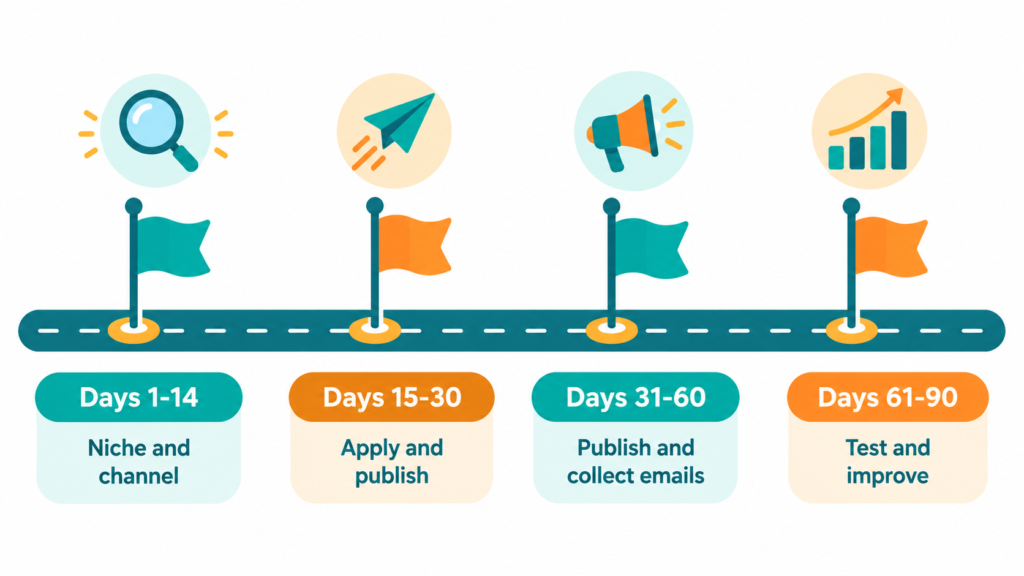
Spend days 1-14 on niche and channel, days 15-30 on program applications and first content, days 31-60 on publishing and traffic, and days 61-90 on testing and improving. The goal for the whole period is a first commission and a tracking sheet with real data.
| Days | Goal | Tasks | Done when |
|---|---|---|---|
| 1-14 (Steps 1-2) | Pick a niche and a channel | Score 3 niches, run the 20 buyer keywords test, choose one channel, set up your profile or site | You have a niche scoring 14+ and a live channel |
| 15-30 (Steps 3-4) | Apply and publish | Publish 3-5 pieces, apply to 3 programs with your live URL, add disclosures | You have at least 1 approved program and 3 live posts |
| 31-60 (Steps 4-5) | Publish and collect emails | Finish the 10-piece starter plan, add an email signup, post video clips or share posts | 10 pieces live and a working signup form |
| 61-90 (Step 5) | Test and improve | Review your tracking sheet, rewrite weak pages, replace low-paying offers | Your sheet shows clicks, and you have a first commission or a clear next fix |
This table also guards against the most common failure. Many beginners quit before day 90, which is before most content has had time to earn traffic.
7 Common Beginner Mistakes in Affiliate Marketing
The most common mistakes are choosing too broad a niche, joining too many programs, and publishing thin reviews. Each one wastes time you cannot spare in the first 90 days. The table pairs each mistake with its fix.
| Mistake | Why it hurts | Fix |
|---|---|---|
| Choosing too broad a niche | You compete with large sites and confuse readers | Use the narrowing ladder and the 4-factor score |
| Joining too many programs | You spread effort and miss payout thresholds | Start with 3 to 5 programs |
| Publishing thin reviews | Readers and search engines see no real experience | Use the proof checklist on every post |
| Skipping disclosure | Risks fines, rejected applications, and lost trust | Disclose at the top and next to each link |
| Ignoring payout thresholds | Earnings sit unpaid | Check thresholds before you apply |
| Relying on one traffic source with no email list | One rule change can erase your reach | Collect emails from week one |
| Quitting before day 90 | Content needs time to be found, and income rises with experience (Authority Hacker, 2025) | Follow the 90-day plan and review at day 90 |
How to Spot Affiliate Marketing Scams and Fake Gurus
Be wary of anyone who charges you to join an affiliate program, promises guaranteed income, or hides real earnings. Legitimate programs are free to join, apart from small refundable verification deposits such as Awin’s (Awin, 2026). Beginners are frequent targets for expensive course upsells.
Watch for these red flags:
- The seller shows screenshots of big earnings but never explains how they were produced.
- The offer guarantees income or promises results in a fixed number of days.
- You must pay a fee to access basic programs that other sources list for free.
- The pitch uses countdown timers and pressure to buy today.
- The seller cannot show verifiable results, such as a live site or channel.
Ask these four questions before you pay for anything:
- Can I get the same information free from official network documentation?
- Does the seller show verifiable results from their own live site or channel?
- What is the refund policy, in writing?
- Does the course promise a result, or does it teach a process?
If the answers are unclear, wait. Everything in this guide can be done for $0.
Frequently Asked Questions About Starting Affiliate Marketing
What is affiliate marketing for beginners?
Affiliate marketing is a way to earn commissions by recommending other companies’ products with a unique tracking link. You get paid when a reader buys or takes a set action. Beginners start by choosing a niche, one channel, and a few programs.
How do I start affiliate marketing with no money?
Pick a niche, create a free channel such as a YouTube channel or a free blog, and apply to free programs such as Amazon Associates or networks like PartnerStack. Publish helpful reviews with a clear disclosure. A domain and hosting are optional upgrades, not requirements.
How long does it take to make your first affiliate sale?
Most beginners who publish steadily see a first sale between month 2 and month 6, though this is an editorial estimate. Income in year one typically stays between $0 and $1,000 a month (QualityUnit, 2025). Faster results usually come from targeting buyer-intent keywords and promoting higher-paying offers.
Do I need a website to start affiliate marketing?
No. A YouTube channel, a newsletter, or social media pages can work, and each program sets its own rules about what it accepts. A simple website still gives you the broadest range of approvals and a home you control.
Is affiliate marketing still worth it in 2026?
Yes, if you treat it as a long-term project. Affiliates with 3+ years of experience earn 9.45 times more than beginners (Authority Hacker, 2025), which shows income compounds over time. It is a poor fit if you need income within weeks.
Which affiliate network is best for beginners?
Awin suits retail and UK or EU audiences, PartnerStack suits software content, and Amazon Associates is the easiest for general product reviews. Choose by your niche and by the 5-point scorecard, not by popularity alone.
How do affiliate marketers get paid?
Networks pay once your earnings pass a minimum threshold, through methods such as bank transfer, PayPal, or Payoneer. For example, Awin pays from 20 USD, EUR, or GBP (Awin, 2025), and ClickBank lets you set your own threshold (UpPromote, 2026). Sales may also be held for a validation period to allow for returns.
Do I have to disclose affiliate links?
Yes. The FTC in the US requires a clear and conspicuous disclosure of your relationship with the merchant (Manatt, 2023), and UK regulators expect a prominent “Ad” label (ASA and CMA, 2023). Most programs, including Amazon, require it too.
Your First 90 Days in 6 Lines
- Choose a narrow niche that scores 14 or more on the 4-factor score and passes the 20 buyer keywords test.
- Commit to one content channel for 90 days instead of spreading across five.
- Join 3 to 5 programs that pass the 5-point scorecard, and confirm they pay to your country.
- Publish the 10-piece starter plan with proof, honest drawbacks, and a clear disclosure beside every link.
- Collect emails from week one, and use the answer-proof-link order so both readers and AI tools can use your pages.
- Review your tracking sheet at day 90, double down on what earned clicks, and keep going, since income grows with experience.